
Big Brother D'Angelo
my first thought and second thoughts of tribute to a creative soul brother

(I thought this piece would be a quick 24-hour turn around but it kept on churning. It may get re-written and churned further in the future)
I’m driving my son to hockey practice, playing a quickly pulled together mix of D’Angelo on the car speaker. The teen is lying back in the passenger seat,his headphones on, asleep. I’m holding onto tears in my chest and in my face that don’t want to emerge as liquid. It’s been about five hours since I first heard that soul legend and Black music master Michael Eugene Archer has joined the ancestors. I’m usually not touched by so-called celebrity passing, but…
Usually, I tell myself that I don’t really know those folk and they don’t know me,
but…
On Tuesday October 14, I greeted everyone I talked to with “I just found out D’Angelo passed.” Every conversation, “How are you doing?” “I can’t talk too long, I just found out D’Angelo passed. I got to get back to it.”
I’ve seen celebrities, superstars, and culture bearers pass. Legends like Michael Jackson, Prince, MF Doom who I appreciated for their musical gifts. But…
This feeling of grief caught me by surprise. It’s taking me a while to sit with this and understand why.
I am and was a big brother to my siblings. For me that has meant mediating small grievances, being a shoulder or two at funerals, morning texts asking about taking out loans, convening emergency family conversations, divining which Orisha to petition for blessings and protection. I never had a big brother by blood.
My spiritual big brother called me today out of the blue. He apologized for not responding in my dialysis/transplant WhatsApp group but he said he’s been keeping an eye on it. I told him, “I just found out D’Angelo passed.” This afternoon, my big brother tells me about the offerings he makes for his family: his daughter who is expecting, his daughter’s adolescent turmoils , his son-in-law’s economics, his daughter’s health. He tells me stories of African Religious community of decades past where we used to visit each other on our homes. When notes were typed up on hundreds of pages and kept in binders passed down to diligent students.
How to be a man of responsibility; what it means to be a mentor to other adults in the world. We greet each other Kabiyesi, a strong lightning strike of recognition when we feel seen by the other, when we celebrate what the other has created with actions, deeds or words. I wish I could have met his mentor Baba Medahochi (ibt) but feel that his swamp magic spirit has brought me to this big brother.
It’s been a few hours (a few days now) and I’ve filled that time with the music of D’Angelo as much as I could tonight when I wasn’t eating dinner, trying to negotiate lower car insurance rates, or taking out the trash.
D’Angelo was a cultural big brother to me. I didn’t idolize him or anything. Looking back in this moment of grief and celebration, I looked for his presence at turning points in my life. My relationship with him was like most of my relationships with men, hot and cold. Moments of intensity and co-creation and years of coolness. Waxing and Waning: niggaz be circular, if you can believe it.
D’Angelo released Brown Sugar when I was graduating high school. My relationship to him wasn’t the childlike admiration reserved for folks like Michael Jackson- a superstar who was larger than life. The singer is, I think only four years older than me. The bigger brother relationship started when I was on the verge of adulthood. About to move from Detroit to California and begin charting my path.
What I remember now is that D’Angelo showed me how I wanted to care for women. That time period blurs together: buying that 88 Escort, my first car, the music of D’Angelo, leaving home for California. I was young for my grade so throughout high school I had to get rides to go hang out or to school parties. D’Angelo sang into me a connection between growing up, driving around, being free to move, to date and to relate.
Take his song “Lady,”
I pick you up every day from your job (You’re my lady)
Every guy in the parking lot wants to rob me of my girl
That’s what the lyrics say online. I had heard “every guy in the parking lot wants to know how you’re my girl.” We love making up our own interpretations to our soulful slurs that move us beyond the literal.
And, of course, the remake of Smokey Robinson’s “Cruisin”
“We’re gonna fly away, you’re going my way, I love it when we’re cruising together”
“and if you want it, you got it forever”
By my sophomore year in college, I was on my way to being a hip hop guy. I could not sing!
D’Angelo’s sensuality, and rugged tenderness– the desire to take care of another and the willingness to be deeply affected by another– planted seeds in my consciousness that was soaking in the indomitable overcoming and overabundant overflowing showiness of my favorite rappers.
It was important for me to hear that sexuality can be an emotional and connective act, not just a process of physical prowess. In today’s lingo they call a demisexual someone who feels attraction only with emotional connection. “Demi” as if the sexuality were partial and not as full as the merely physical. Huh.
D’Angelo was a man who feels pain and joy deeply and expresses his willingness to lose control, to lose himself in ecstasy, not merely to be the cause of another’s, his woman’s delight. I never heard him traffic in the sexual slang that surrounded our developing masculinity such as “beating” “pounding” “taking.”
Like Marvin Gaye he blended religious ecstasy and sensual ecstasy until they became the same internal feelings meet external vibes in a metaphor of medley, a symphony of stank.
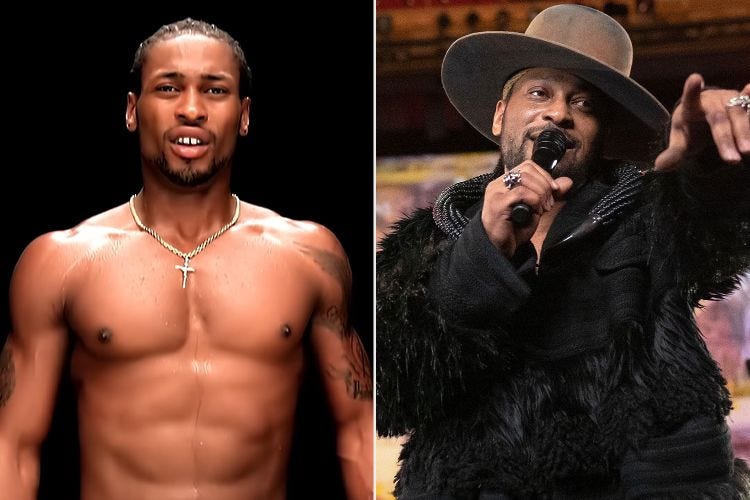
As a male/man/masculine navigating kidney failure since the age of 12, labelled as underweight and slow motion for my developmental years, I needed affirmations of my gifts that were not found in physique and moving the material. It’s ironic that I found these in D’Angelo, who caused an estrogen storm with his divinely chiseled physique unveiled in the subtle unsubtle video for “Untitled (How Does it feel).” His music and his interviews reveal that he knew he was much more than an attractive body. He was a caretaker of soul culture.
Perhaps D’Angelo was my first shaman. I was not a crooner, but MC means move the crowd. D knew what he was doing “performing” these sacred acts of creation and sharing, of stirring up energies.
“Let the music take your mind. Just release and you will find.”
Of course, the first connotations we heard were sexual, but I also heard and felt an avatar honoring the energy of witness that the audience was offering. I’d do my best to embody that soulful facilitation when I rocked mics, moved crowds, stood on stages.
His second album Voodoo came out in 99 or 2000 as I was calling myself an “ex-Christian” and just starting to explore my own existence as a multidimensional African. Around that time, I took a trek to see a Vodun priestess and she laughed at how much I still feared “devilish influences”. The temple was a portal which shifted energetically beneath my gaze as she chided me for “being brainwashed real good.” My gaze swirled and all of existence became fuzzy. This wasn’t low blood pressure, but a liminal space between worlds. I wasn’t ready for Vodun at the time, but I was ready for Voodoo.
Well before the internet shops, hoodoo queens and Nigerian princes, D’angelo was the sound of hoodoo to me. Big brother gave me something I could feel one part Africa, one part funk, one part Southern. One part beyond me, one part permission to grow. Isn’t that what big siblings give you?
Me and my big brother in the religion are priests of Sango, the charismatic embodiment of dance and drum. Before I knew what an Orisa was, I was entranced by the was D’angelo worked it, building a liminal space between Saturday nite and Sunday morning, between the fucked up and fuckin,’ between the African and the Black.
D’angelo and the Black Messiah came out in 2014, the same year as my mixtape SOL SWGGR. By that time, I had ten years under my belt as an indie artist and a couple years as a solo hip hop artist. In the last decade since, whenever I wanted to reset as a creative performer, I’d get reacquainted with J Dilla, and this brought me back to D’Angelo. They were together as Soulquarians and forever changed Black music, American music, pop music.. I loved hearing the stories of how they’d watch concerts together, analyzing and breaking down their favorite jams into their ingredients to cook up new recipes. They’d work in the same building, going to each other’s studios to add rhythms, layer vocals, give feedback. Steel sharpen steel as we say round here.

Both had in common how much they lived and loved music, its legacy, its shape, its power.
Both had in common a reluctant relationship to fame, but were moved by creativity and commitment to culture.
I just remembered that I had written a song called “Brothers Dance” maybe five years ago. It’s one of the songs that were interrupted by the pandemic and then a laptop theft. The chorus’s first line was from a poem by Etheridge Knight “when brothers dance together, then freedom won’t be long. When brothers sing together, can’t wait to hear that song.” I had intended to have Shamako Noble, Bay Area hip hop OG and prolific cultural organizer feature on the song. At times he was a hip hop mentor to me. I owe him a phone call. His sons are now young adults navigating identity, relationship, economics, emotions. All the things D sings about. Shit. Damn. Mothafucka.
I didn’t have words for any of these things at the time I was living it.
When your brother passes, you find new words. His energy becomes an empowerment to you. You hold the lessons he taught you and you recognize them in your own walk, your strut, the bass of your voice, the rhythms you make into home. I’m not just talking out my ass. My younger brother Lee shot himself in his bedroom in 1997, while I was away in California and his lessons are still unfolding in my Detroit Afrikan soul almost 30 years later.
While bopping around D’Angelo videos, I saw a Tiktok about how he’d go award shows solo without his partner Angie Stone because the record producers who financed his musicality didn’t want him on the red carpet or on stage with a pregnant woman or with a child.She had to take a separate car I didn’t know he had three children. I think about how he wasn’t able to brother me in the divine art of fatherhood, even though he lived it. I just learned, while writing this essay, that he had three children. There were structural and cultural barriers towards him making that sort of music — that would portray him as a soulful Afrikan father— for mainstream distribution.
(Shout out to Mic Audio, Dow Jones, Bryce Detroit, Mixo, Wood Zombie, SubVerso, Will See and our too short lived Dad Raps, Baba Gang Detroit underground hip hop movement. Forgive anyone that I left out unintentionally. We had to shout into the ethers what the industry didn’t want our people to hear.)
Watching the sun purple pink and red on my rear view mirror, pulling up to the hockey arena. Press pause on the playlist.
Guess that means this essay is done.
Smile, brother, smile…
I have to get a tall white candle soon.
Potent word-strike! Like lightning slowed to a gentle fix of nitrogen for hungry soil . . .