
Place
this is still the place where I live. sometimes people are creative here. sometimes people are shot here. this place has a history. how about yours?

250 years of America
I wrote this post on a trip to the Northern Great Lakes to visit my partner’s family of birth. We were there on July 4th and we saw the fireworks show- the tail end of the small town community holiday celebration. Earlier in the day, they had a pancake breakfast, burger cookout, and pig roast. I arrived with her family. As we pulled out blankets and unfolded our chairs, young adults rolled up to our left on ATVs and four wheelers and parked next to each other to watch the fireworks. On the baseball field to our right, men pitched and played the infield for boys and girls lined up to kickball and run bases.
Before the fireworks “burst in the air” with a diversity of bright colors and air-shattering explosives, I saw my son and my partner’s nephew playing basketball with a dozen other kids and teens. He saw me, said hello, then waved me off so he could keep playing.
Just a few weeks before, on June 22, 180 teens and kids were zip tied, detained, and marched onto city buses at the Detroit Freedom Fireworks. The printed curfew was 8pm, yet the roundup began at 7:50. Their parents were walloped with $250 fines. Often parents, guardians, or grandparents were at another location at the Fireworks, scared or confused with their kids disappear and then must be ransomed back. From what I could read, the police did not give the kids an opportunity to call someone or to be picked up while still at the festivities. The city’s mayor and police chief called the night “peaceful” and lauded it a “success.”
What in one community could be a playful and necessary adolescent rite of passage of claiming autonomy from one’s parent -may be a criminal affair in the internal colony of Detroit. My son waved me off and I went over to the other side of the park.
Another incident was a part of that officially successful night:

As BYP100 reports, “An 18-year-old father was shot in the back by Detroit police during the fireworks. He ran because he was scared. And now—after being handcuffed to a hospital bed for six days, denied access to his mother, and treated as a criminal while fighting for his life—he faces trumped-up charges. His name is Alonzo Lee-Perkins. He has a 7-month-old daughter. He loves music, he loves making people laugh, and he has a future that nearly ended on a summer night.”
Local activists are raising money to support the family of Alonzo Lee-Perkins for his loss of income and for legal protection from the charges filed against him. Your support, donation, or forwarding their Support Now appeal would be a huge help.
Riverwise “trust the current”
We saw this coming 14 years ago. From 2010 to 2016 I worked with the East Michigan Environmental Action Council and helped support a group of Detroit teens and young adults. After the police stopped and harassed a couple of the teenage members of the Young Educators Alliance at the 2012 Thanksgiving Parade, we made sense of it as a group. They felt frustrated, disheartened, and angry but above all, confused by being made to feel unwelcome in what they thought was their city as Black Detroiters. From these observations we began discussing the gentrification of Detroit. They decided to organize a community forum, Feed 1 Teach 1, and invited the community to come in to figure out what changes were afoot in the post industrial Motor City.
These first alarms for the encroaching gentrification didn’t come from the policy watchdogs, nor were they the result of watching property values or changing demographics. These effects would be seen later. They came from teenagers– Black Detroit youth who were chillin outside, not with graduation caps, business suits, or certificates of employment or scholastics to make them “worthy” of mainstream applause- just regular ass youth being themselves in public.
They felt the weight of being policed and excluded, being told without words that the Chocolate City would not be theirs any more. They put out a call and the community came to listen, telling them that they had their back. The loss of life is the most painful part of police violence, but it is too often used to disrupt and weaken entire communities.
This summer what’s especially heartbreaking to me was the local social media commentary that followed in the days after the Detroit incidents.
I’m talking about the Black folks my age maybe younger maybe older saying that saying that Black teenagers need to be supervised constantly in public, Black teenagers deserved to be arrested for trying to hang out, saying that this portion of our community deserves to be treated horribly to make everyone feel safe. Too many say that Black parents were being irresponsible not keeping their 14,15, 16, or 17 year olds within arms length and that their families deserved the fines and punishments. It’s sad how now we are normalizing the privatization and gentrification narratives amongst each other. No, against each other.
While I was up north watching a self-proclaimed American community give each other the space to play freely, I almost teared up knowing how the police had been sicced on Black youth, bussed out of the downtown and ticketed while not even being given a chance to call their parents or guardians who may have been just a street over!
What’s worse is that this summer, this line of thinking led to a young man being shot that evening. In the occupied city, the teens who are carted off for curfew violations are being groomed to grow up to be the young adults who are shot or shot at by law enforcement for expressing fear of the police whose job it is to buffer their own communities, to protect the investors and the property owners from their fear of youthful expressive energy.
Saying that young Black teens should be treated like humans and community members has become a “radical” position. Criticism of gentrification, or specifically the recognition that gentrification depends on policing has become a “radical” position.
Our dependence on this skillfully funded and engineered arts, media, and social media landscape has shaped our communities’ communications in ways that we are still wrapping our heads around. We’re losing our Black city even while Black officials congratulate themselves in their governance and many of our neighbors repeat the same slogans used nationally to justify why we never should have been governing ourselves in the first place.
How did we get here?
The best I can answer is that neoliberalism is the corporate hustle that takes advantage of genuine skepticism, pain, and doubt to position corporations, developers, billionaires, and privatized entities as the social solutions while deteriorating public deliberation and decision making as viable options to making anything worthwhile happen.
My newest published essay “Dear Young Detroit” traces an outline of the history that has brought Detroit from an Afrikan city that fought for self-determination to a gentrified symbol of rebirth. My personal story tells a Detroit story from the Great Migration north to a renaissance grassroots maligned as Black brutes trying to unify against suburban and State opposition to a confused city looking for business opportunities and the right hustle to resucitate it.
“Dear Young Detroit” was published in the Summer 2026 issue of Riverwise magazine. This community-based magazine is one of my writing homes that I love for my works to visit. It was created by a team of authors, writers, photojournalists, parents, grandparents, students, organizers, activists, artists, educators, and visionaries. They work to create media that reflects local activism and the profound new work being done in and around Detroit neighborhoods.
“Dear Young Detroit” is one of the personal essays in my collection, collapse- Notes from The Detroit Underground (in progress). I started out wanting to write about why I don’t apply for Kresge Foundation recognitions, even though it is currently the singular art world taste maker of our city. My personal experiences in the struggles against emergency management and the philanthropic takeover of the city left a long lasting taste in my throat. In writing this piece, I struggled to find the balance between the personal and the historical. The essay didn’t really click until I revised it into a letter to a younger activist who I’ve known and worked with for the last ten years. I wanted to explain how this “new normal” of our city has been manufactured.
At first, 10-15 years ago, we perceived gentrification as an attack on our collective. The corporations and philanthropists have gotten better to emphasize their collaborations and donations and justify the displacements as making the place better, just as they are working to justify the shooting of Alonzo Lee-Perkins. Instead of seeing him as a son and a father, a young person working and trying to have fun on Ford Fireworks night; he is going to be depicted as a Black gun wielding thug, an obstacle to progress. He already faced police bullets; can’t you see the narrative counterattack on its way?
This gentrification thing, this exclusion and fear, this grasping for safety has penetrated deep into our communities. It’s funded and encouraged so that we welcome being occupied and no longer look towards each other with creativity and trust.
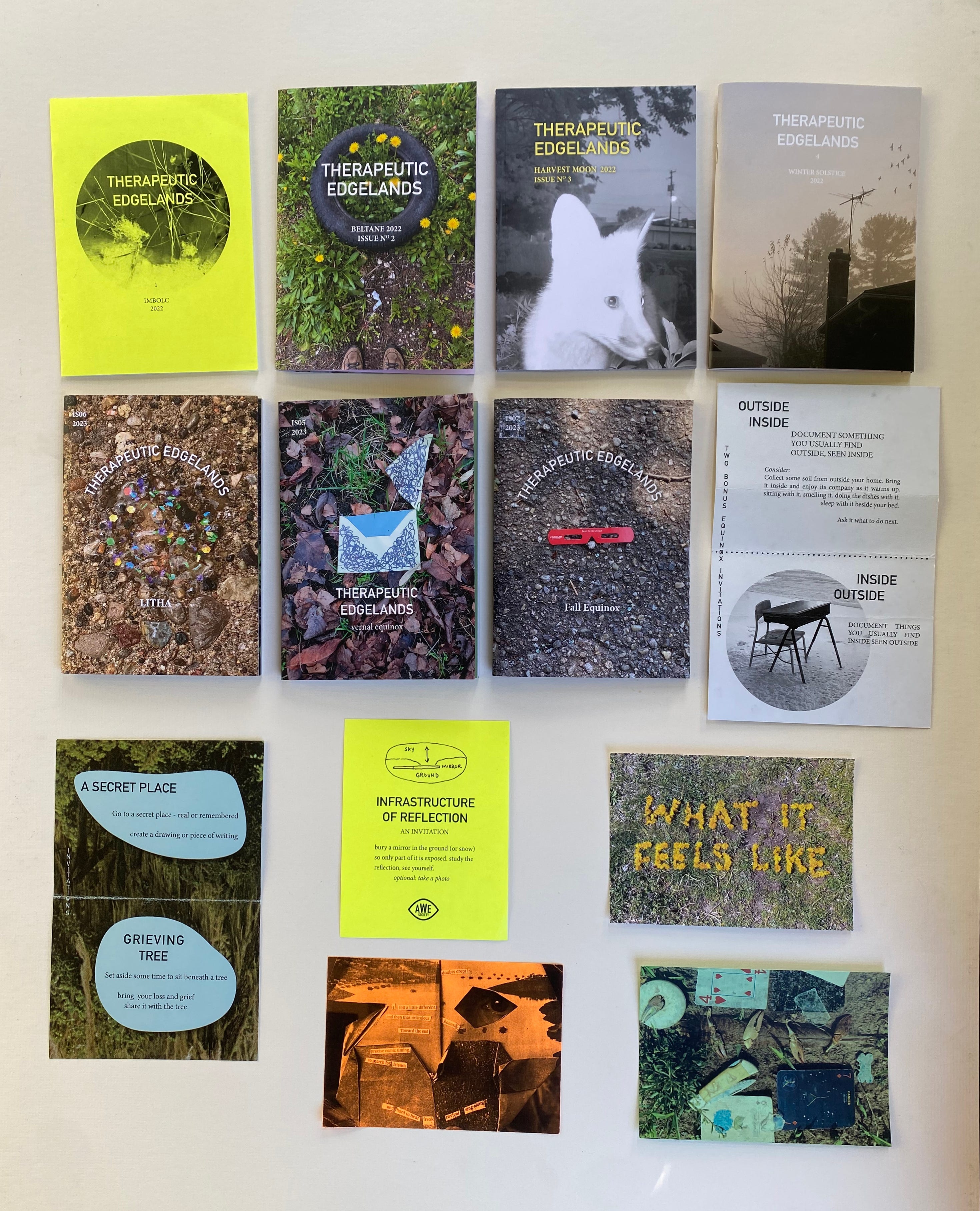
The Edgelands: a changing place, way of relating, and creative expression (yours?)
Speaking of safety, Bridget Quinn, founder of AWE Society Press, learned in Austin Texas, how art is funded strategically to take over communities of color by making them “safer” for white consumers. She noticed how her own public art projects were primarily placed in neighborhoods that were at the threshold of gentrification.
In the 14 years since leaving Texas, she has been investigating how to make art without the approval of the art world.
“Speculators see art as a tool for gentrification and artists can be dumb in their process” Quinn says. “Art as we do it is about transforming yourself into the type of person that can inhabit a place well. And about having the type of relationships that can hold us together within creation.”
The “art world” sees itself as a vehicle for Western culture. Even when individual artists want to make the content of their art “relationship to nature” or “divine essence,” their work can be used by “placemaking” institutions such as museums, business improvement districts, or real estate developers in process that actively extract and exploit the environment and the internal colonies of their country.
The city of Austin’s slogan was “Keep Austin Weird” as city managers did everything they could to manicure and homogeneize the city so that the slogan became a mere marketable image. They “curated” what kind of plants could grow, what kind of businesses could be in a place, what kind of resistance and organizing was tolerable, what kind of people would feel comfortable in that city. Art has been a central part of this process.
This history has brought Quinn to zine making and the realm of the indie press. They have brought her to collaborative publishing and to the Edgelands, where we met and collaborated. Instead of being a place that has a single vision imposed upon it, the Edgelands are visibly and consciously co-authored by many different beings: living and ancestors, spirits, more than human forces, histories and mythologies.

We’re in the last week for entries to the Edgelands Nonfiction contest, but it’s NOT TOO LATE! We’d love to read your work that looks at place below the surface, below common narratives. Crack open the lies, misperceptions, and the gaze of glazed eyes and walk us through the places you know.
Thank you for walking with me through the Detroit that I know. It’s a long journey so please keep returning to the Calabash and we’ll walk a little further next time.
Stay cool. Look out for each other.
This piece is so spot on. Some of the older folks at the food pantry where I've been serving have been echoing the statements of needing more supervision and more regulation and it's immensely frustrating. And the notice of art going up in places marked for gentrification is so eerily accurate it's uncomfortable, I'm looking forward to reading more about this and continuing to grow as an artist who does not aim to please in any way.
We are from the USA but raising our children abroad. Telling my son about this and to him it sounds insane. Our white family in the USA would rationalize it. Why wouldn't they? Its not happening to them and stories framed like this are unquestioned.
https://eu.detroitnews.com/story/news/local/detroit-city/2026/06/23/detroit-ford-fireworks-teen-curfew-violations/90656282007/